
The Logic of Money
Discover why the system rewards what can be measured, scaled and turned into profit, even when it does not serve people, society or the environment.
How Money Reprogrammed Humanity
What if many of your everyday decisions are not as free as you think?
“Życie w akwarium” (“Life in an Aquarium”) brings together evidence from research, reports, analysis and real examples to show how the logic of money shapes our choices, work, relationships, health, environment, education and the direction of entire societies. The book is currently available in Polish only.
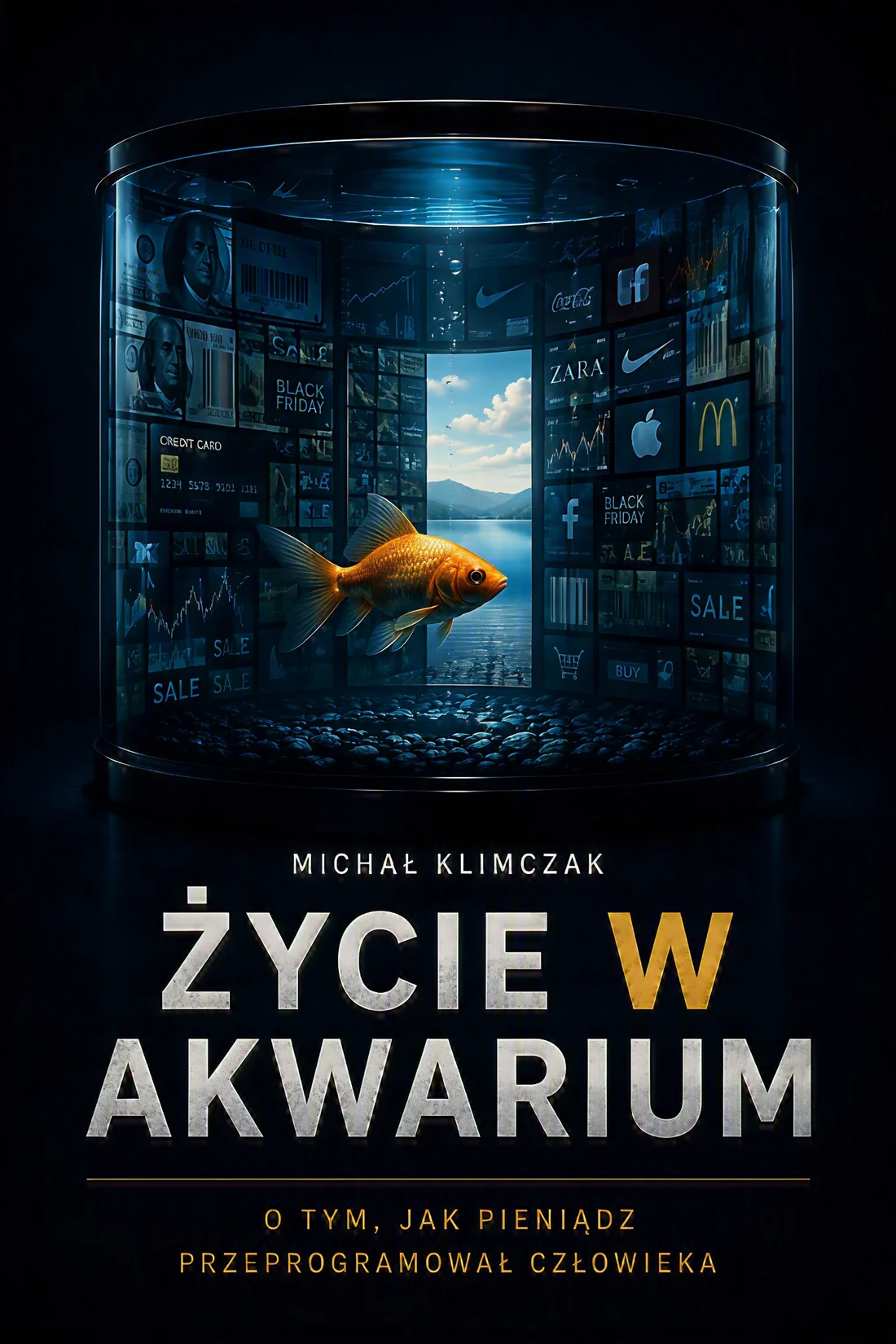
From our earliest years, we learn that everything has a price. Work, time, security, housing, education and health are all drawn into a single system of accounting.
“Życie w akwarium” examines money not only as a medium of exchange, but also as a mechanism that shapes behaviour, motivation, relationships, social hierarchies and the direction of economic and technological development.
The book sets out the benefits of money, examines its consequences, addresses the main objections and describes communities and models that show how social life can be organised differently, in ways more in keeping with human nature.
You will see it as a system of incentives that shapes what we produce, how we work, what we desire, how we judge others and which solutions we consider possible.
Discover why the system rewards what can be measured, scaled and turned into profit, even when it does not serve people, society or the environment.
Explore how advertising, social media, brands and external rewards shape our needs, motivation, choices and sense of self-worth.
See the connections between planned obsolescence, ultra-processed food, status pressure, inequality and difficulties with motivation.
Discover examples of communities, education, self-organisation and cooperation that show money need not be the only thing governing our relationships.
Most books stop at a diagnosis. “Życie w akwarium” goes a step further. After examining how money affects people, society and the course of civilisation, it asks whether the world could be organised in a way that reduces those effects without creating even greater problems.
The book considers the potential benefits and risks of such a change. Its conclusions draw on scientific research, historical experience and contemporary communities that have lived by different principles for years.
This is not a book about why the current system is bad. It asks whether a realistic alternative exists, and what opportunities and risks would come with putting it into practice.
For readers interested in how money affects the mind, relationships and society, as well as advertising, consumption, health, the environment, education, the organisation of work and alternative ways of organising social life.
Download the sample PDF in Polish to explore the narrative, the way observations are connected with source material, and how the conclusions are drawn.
Download the Polish SamplePDF in Polish • no registration • no purchase required
You can order a copy for yourself or give it to someone as a Gest Dobra — a gesture of kindness. Both options are for the Polish-language edition.
Choose this option if you are buying “Życie w akwarium” for yourself. Read it, weigh it against your own beliefs, challenge its arguments and examine the cited sources for yourself.
Give the book without creating a debt or expecting a favour in return. Let it be more than an ordinary present: a freely given act of kindness and an invitation to pass kindness on, if the recipient ever feels moved to do so.
“Życie w akwarium” shows how deeply a transactional mindset has entered our relationships. Gest Dobra is a practical response to these observations: doing something for another person without payment, debt, an obligation to return the favour or a desire to enhance your own image.
Discover the Idea of Gest DobraBook sales are still being prepared. Please check back soon — this button will become active when sales open. The book is available in Polish only.